
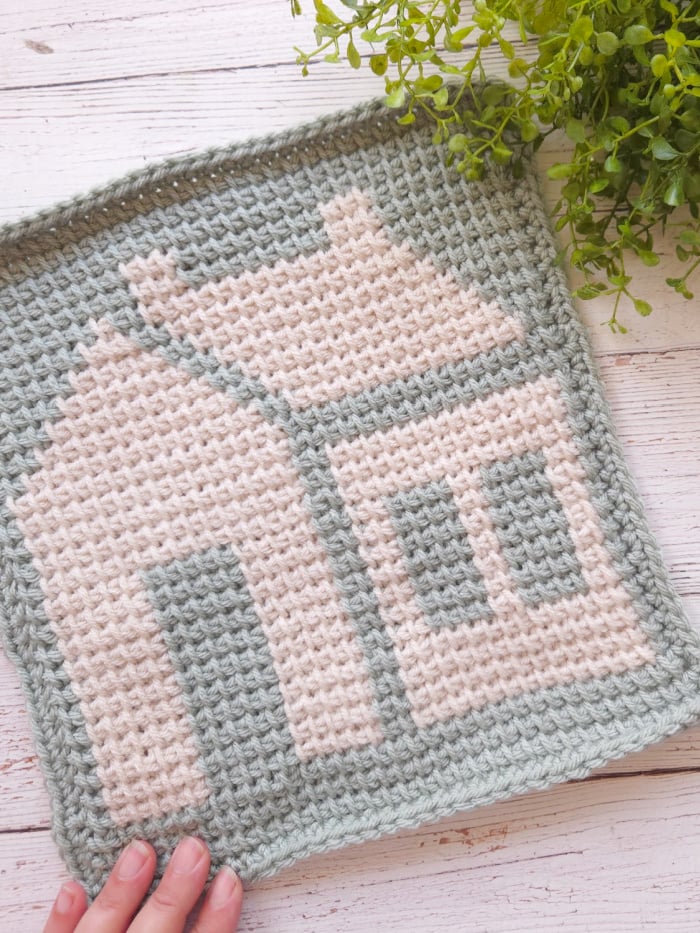
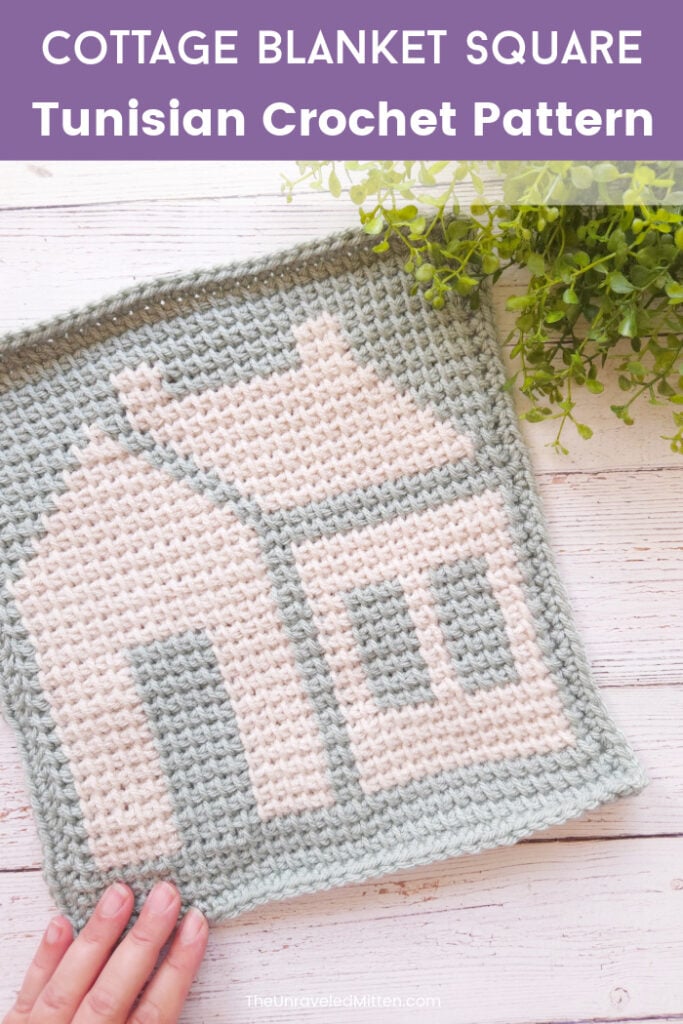
Learn tapestry and intarsia Tunisian crochet colorwork techniques by making this cozy cottage blanket square.
What is a Country Cottage Blanket without a cozy cottage house? This is block 15 of our 2026 Tunisian crochet along. It’s not too late to join the fun. You can find all the details you need to get started here.
A new square pattern featuring a different Tunisian crochet stitch or technique every other week throughout the year.
Print + Crochet in Comfort
You can find a low-cost AD-FREE printable version of this crochet pattern in my shop. You can print it out or use it digitally on your devices. This is a pre-order, so you will be sent a new PDF each time a square is released.
You can also find this pattern on Ravelry .
Tunisian Crochet Colorwork Basics
I think this is my favorite block of the whole blanket! I enjoyed making this one so much, and I want to make a bunch for a whole blanket.
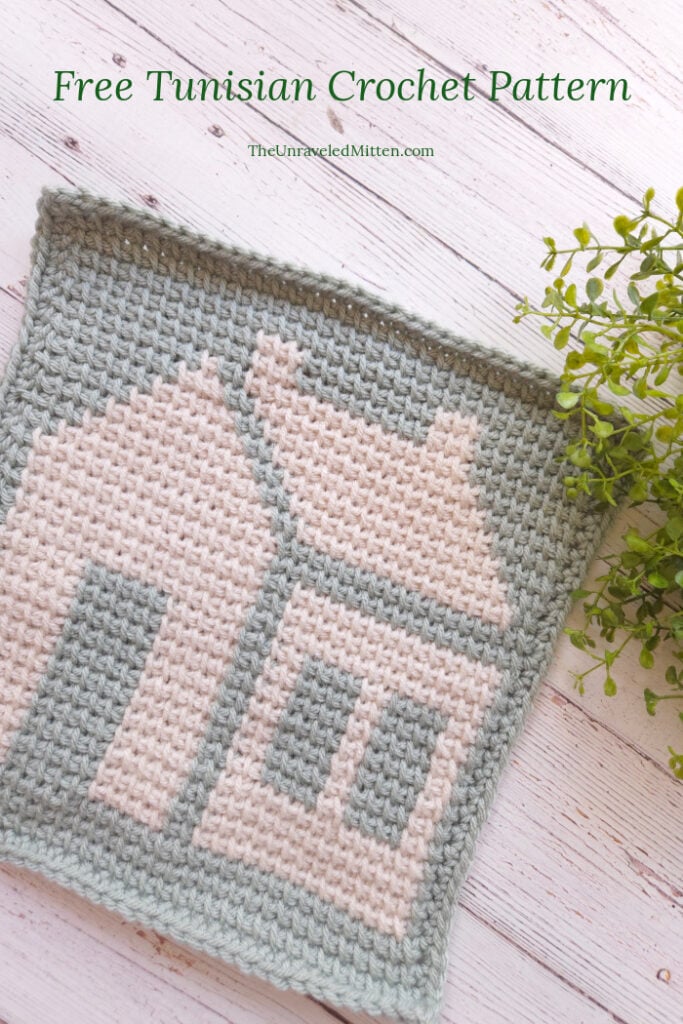
The colorwork methods I used for this block were Intarsia crochet and tapestry crochet.
Intarsia colorwork features larger blocks of color and often uses multiple balls of yarn (you might see them called bobbins). I used this method for most of this block.
Tapestry colorwork has smaller color changes, and the yarn is floated or carried across the back. I used this method for the smaller color change sections, like between the windows and between the front and side of the house/roof and chimneys.
Tapestry crochet colorwork on tunisian crochet can be a little tricky because you either have to trap your yarn and carry it across or let it float loosely at the back of your work. I trapped my yarn and carried it along for those small color change spots listed above.
MaeCrochets on YouTube has a fantastic tutorial showing how to do this that I highly recommend watching if you’re unfamiliar with this technique. I will link it below in the notes.
Materials and Pattern Information
- 120 yds worsted weight yarn in 2 colors, I Love This Yarn used in sample
- Split Background color into 6 balls
- Split house color into 5 balls
- 6.5 mm Tunisian crochet hook
- 6 mm crochet hook (for border)
- Scissors + Yarn Needle
Gauge and Sizing
- Gauge: 6 sts x 6 rows = 2 in
- Worked in pattern stitch
- Finished Size: 12 in x 12 in after blocking
Abbreviations
- US Terminology
- Ch(s): chain(s)
- Yo: yarnover
- Tss: Tunisian simple stitch
- Lts: last Tunisian stitch
- Sc: single crochet
- Sl st: slip stitch
Special Stitches
Tunisian Simple Stitch (TSS): Insert hook from right to left under the vertical bar of the stitch, yarn over, pull up loop.
Last Tunisian Stitch (LTS): Insert hook from right to left under 2 vertical bars at edge of work, yarnover, pull up loop.
Standard Return Pass: yo, pull through 1 loop, *yo, pull through 2 loops, repeat from * across until 1 loop remains on hook.
Notes
- Last loop on the hook after return pass counts as 1st loop of next row forward pass
- Some curling is normal
- VIDEO: Colorwork Tutorial from MaeCrochets
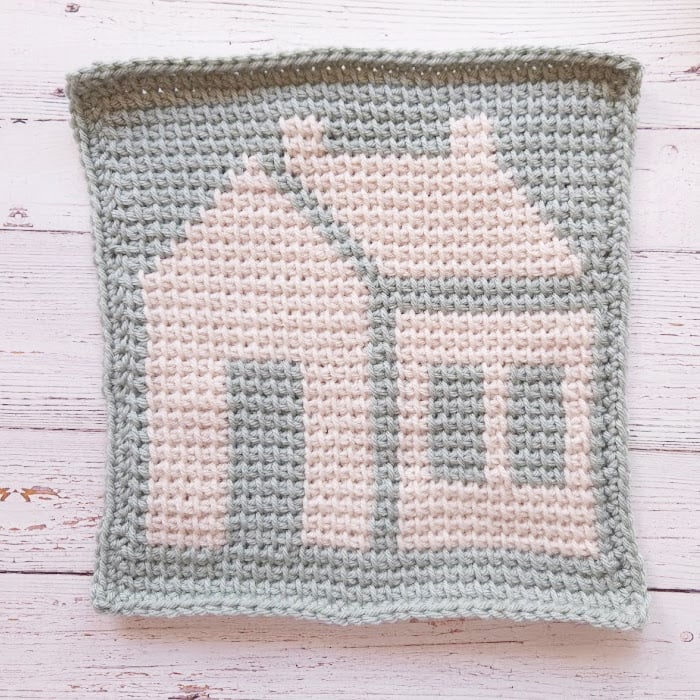
- Follow chart for color changes. Read chart from right to left.
Cozy Cottage Square Written Instructions
Foundation Row 1: Using chosen background color, ch 35. Insert hook into 2nd ch from hook, yo, pull up loop. *insert hook into next ch, yo, pull up loop. Repeat from * across, keeping all loops on hook. (35 Loops). Complete standard return pass.
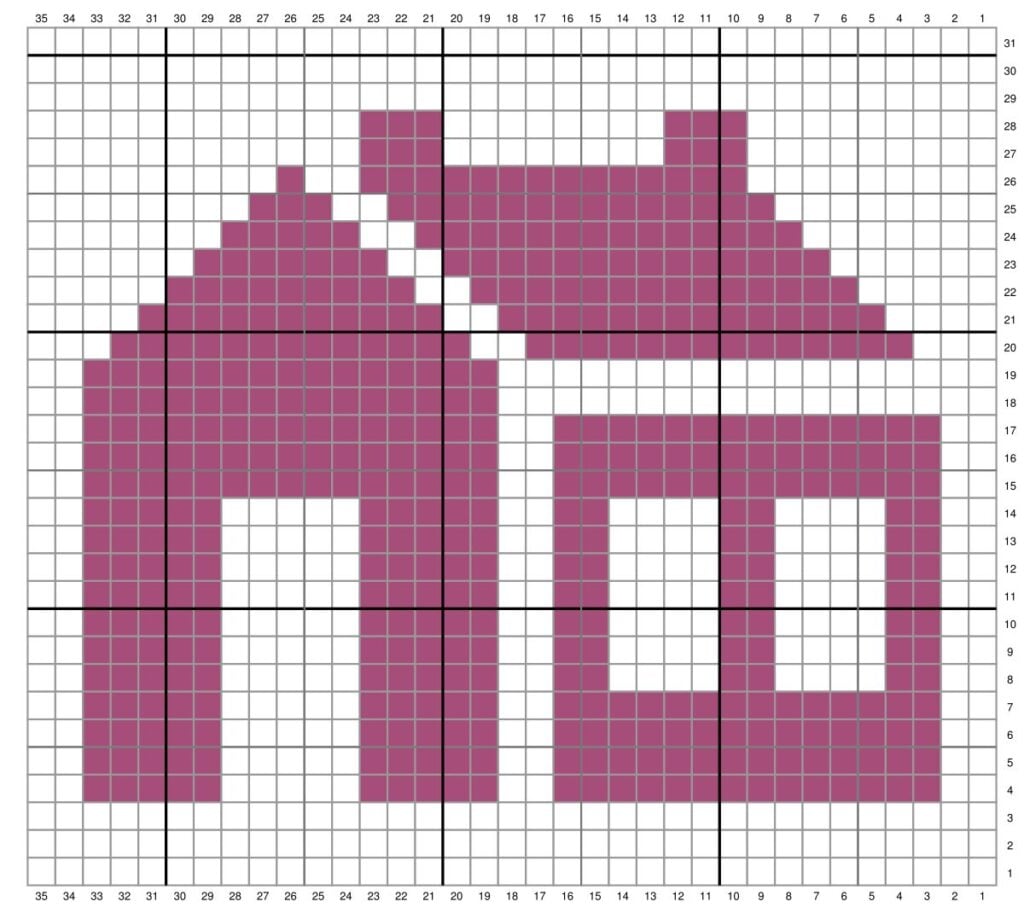
Row 2-31: *TSS across until 1 bar remains unworked; follow chart for color changes. LTS in final stitch. (35 loops). Complete standard return pass.
Bind off Row: Insert your hook under 2nd vertical bar. Yo, pull through the vertical bar and loop on your hook. *Insert your hook under next vertical bar, yo, pull through the vertical bar and loop on your hook. Repeat from * across. Continue to border.
Border: Do not finish off. Using 6 mm crochet hook, ch 1, sc evenly around, placing (sc, ch 2 sc) in each corner. Join to top of 1st sc with slst. Finish off, weave in ends. Block to 12 inches. (35 Sc on each side)
**Note: the number of single crochets worked on each raw edge should be the same number as the top and bottom edges. You may have to add or subtract stitches to get 35 on the raw edges. Each square will have around 35 (+/- a couple stitches, depending on the stitch multiple) to make joining easy and flat.
Very disappointed that the written pattern does not explain the techniques required and that I had to find another tuition source to be able to do the square. It was the same with the last square too, I had to get instruction elswhere because the written pattern was incorrect. To enable this to be future resource when the video tuition may no longer be available I am going to have to learn the technique and then write it into the pattern