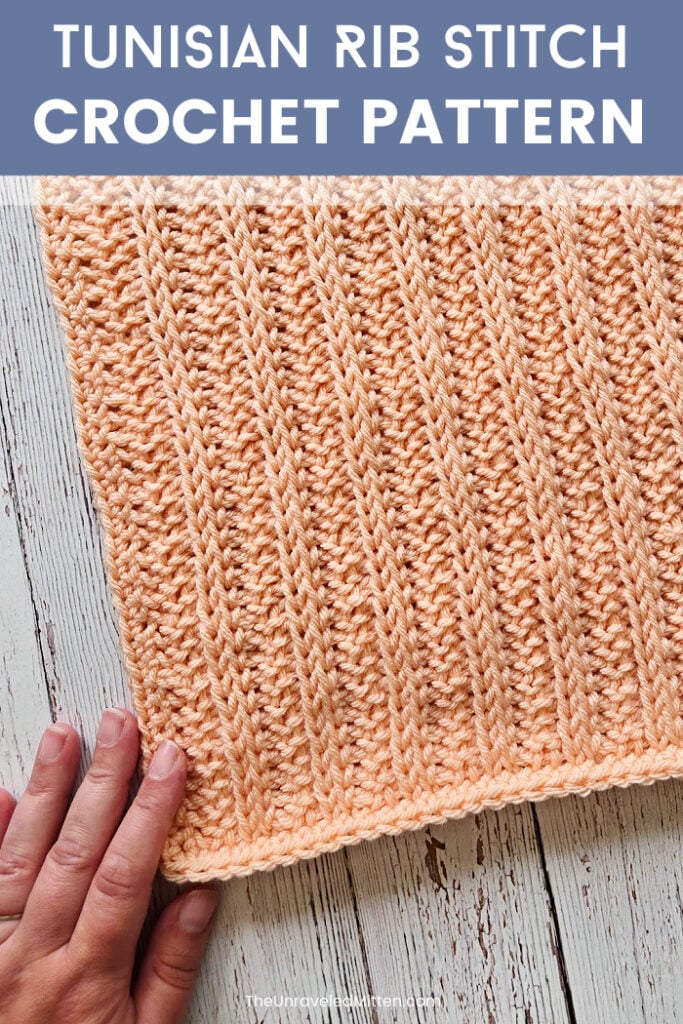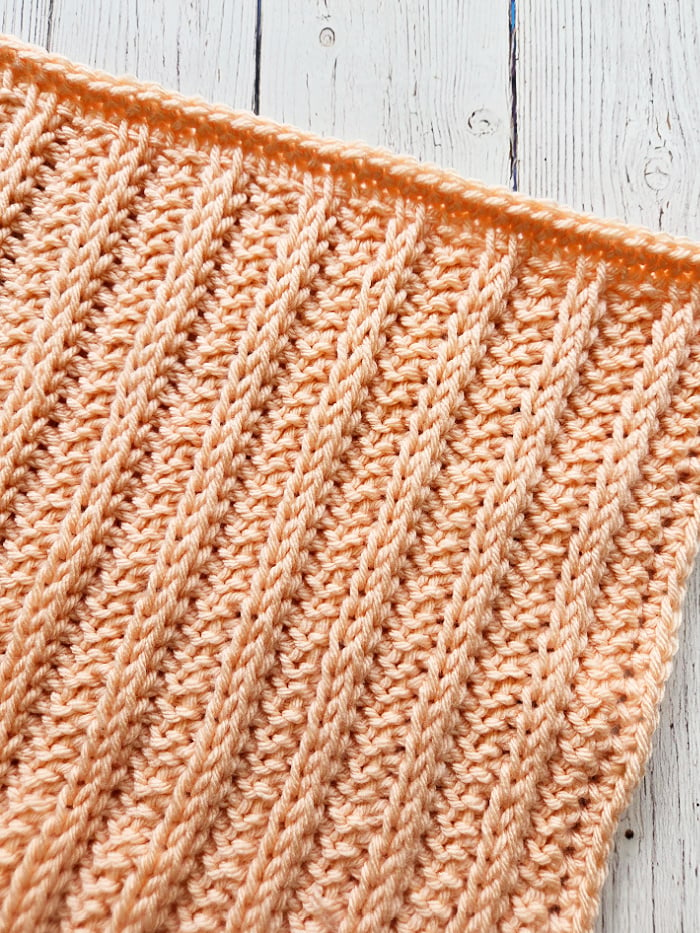
The Tunisian crochet rib stitch features a repeatable sequence of Tunisian knit and purl stitches, which creates a striking vertical pattern
This is the 10th block in the Country Cottage Tunisian Sampler, our 2026 year-long crochet along. We are halfway!! It’s not too late to join the party. You can find all the details you need to get started here.
Every other week throughout the year, a new square pattern featuring a different Tunisian crochet stitch or technique will be released.
Print + Crochet in Comfort
You can find a low-cost AD-FREE printable version of this crochet pattern in my shop. You can print it out or use it digitally on your devices. This is a pre-order, so you will be sent a new PDF each time a square is released.
You can also find this pattern on Ravelry .
Modifying the Tunisian Rib Stitch
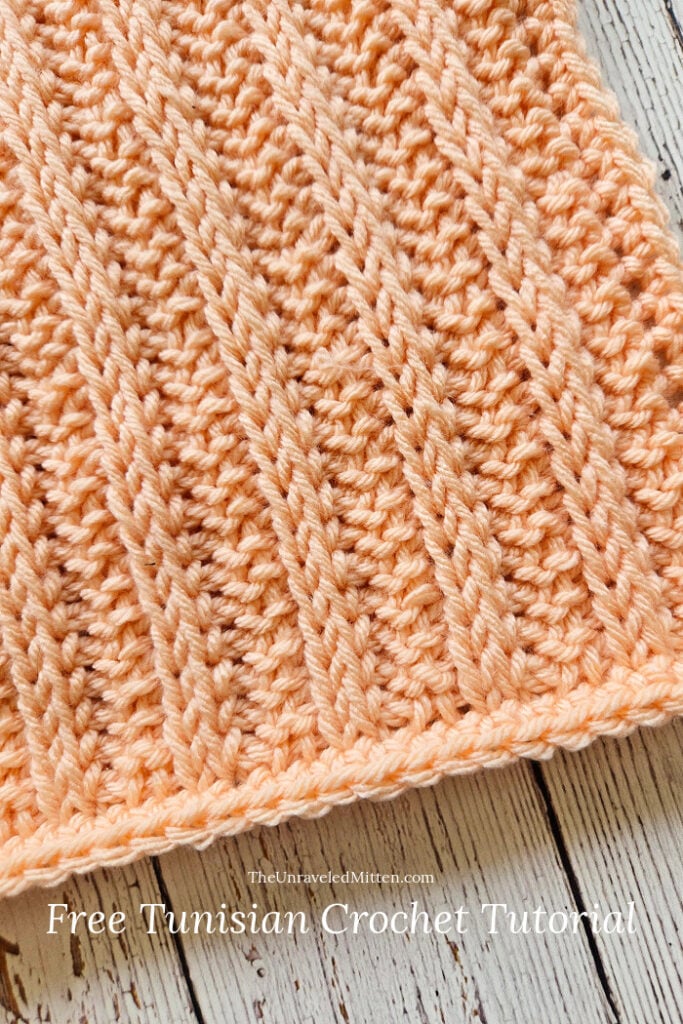
The Tunisian rib stitch is made by crocheting a sequence of knit and purl stitches across a row, just like in knitting. However, unlike knitted ribbing, this stitch has no stretch to it. There are many different combinations of knit and purl stitches you can do. Here are some popular ones. Note that each of these would have a different starting multiple.
- 2 knit + 2 purl – we are making this one today!
- 1 knit + 1 purl
- 3 knit + 1 purl
- 3 knit + 2 purl
In order to figure out the stitch multiple, add up how many knits and purls in 1 repeat – we will use 2×2 as an example.
2 knits + 2 Purls = 4 stitches
Because we are starting with the purl stitches, take that number and add 2 to it for the first and last stitch of the row.
2 purls + first stitch + last stitch = 4 stitches
So using this example, we know we need to chain a multiple of 4 for the repeats and then add 4 more chains to account for the extra.
I also have a dishcloth pattern that uses this stitch! It is slightly different because we start with a knit stitch instead of a purl stitch.
Materials and Pattern Information
- 120 yds worsted weight yarn, I Love This Yarn used in sample
- 6.5 mm Tunisian crochet hook
- 6 mm crochet hook (for border)
- Scissors + Yarn Needle
Gauge and Sizing
- Gauge: 6 sts x 6 rows = 2 in
- Worked in pattern stitch
- Finished Size: 12 in x 12 in after blocking
Abbreviations
- US Terminology
- Ch(s): chain(s)
- Yo: yarnover
- Tks: Tunisian simple stitch
- Tps: Tunisian Purl Stitch
- Lts: last Tunisian stitch
- Sc: single crochet
- Sl st: slip stitch
Special Stitches
Tunisian Knit Stitch (TKS): Insert hook from front to back between front and back vertical bar, yarn over, pull up loop.
Tunisian Purl Stitch (TPS): With yarn in front, insert hook from right to left under vertical bar, yarnover, pull up loop
Last Tunisian Stitch (LTS): Insert hook from right to left under 2 vertical bars at edge of work, yarnover, pull up loop.
Standard Return Pass: yo, pull through 1 loop, *yo, pull through 2 loops, repeat from * across until 1 loop remains on hook.
Notes
- To modify size chain any multiple of 4
- Last loop on the hook after return pass counts as 1st loop of next row forward pass
- Minimal Curling
- Tunisian Crochet Tutorial Playlist
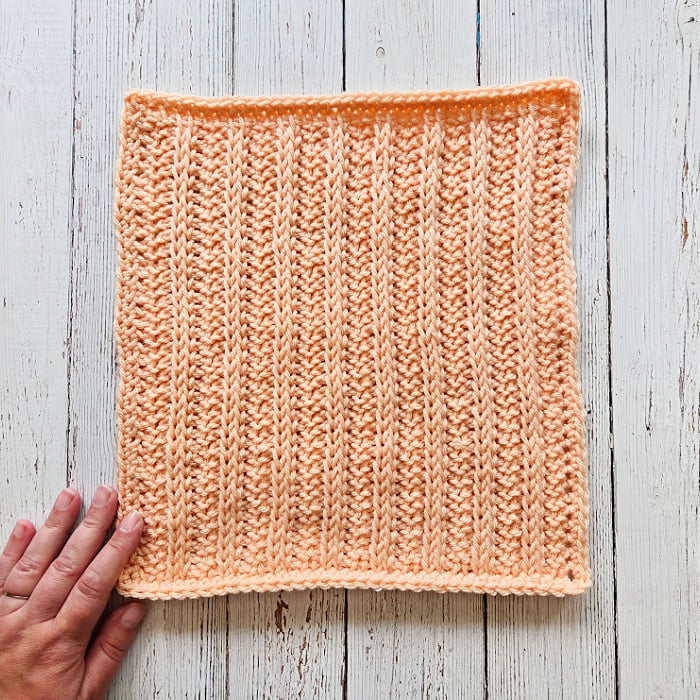
2×2 Tunisian Rib Stitch Blanket Square Crochet Pattern
Foundation Row 1: Ch 36. Insert hook into 2nd ch from hook, yo, pull up loop. *insert hook into next ch, yo, pull up loop. Repeat from * across, keeping all loops on hook. (36 Loops). Complete standard return pass.
Row 2: *Tps in next 2, Tks in next 2. Repeat from * across. Lts in final stitch. (36 loops). Complete standard return pass.
Row 3-End: repeat rows 2 until the block is square. For me, this was 37 rows.
Bind off Row: Insert your hook under 2nd vertical bar. Yo, pull through the vertical bar and loop on your hook. *Insert your hook under next vertical bar, yo, pull through the vertical bar and loop on your hook. Repeat from * across. Continue to border.
Border: Do not finish off. Using 6 mm crochet hook, ch 1, sc evenly around, placing (sc, ch 2 sc) in each corner. Join to top of 1st sc with slst. Finish off, weave in ends. Block to 12 inches. (36 Sc on each side)
**Note: the number of single crochets worked on each raw edge should be the same number as the top and bottom edges. You may have to add or subtract stitches to get 36 on the raw edges. Each square will have around 36 (+/- a couple stitches, depending on the stitch multiple) to make joining easy and flat.